
Palazzo Massimo alle Terme
The museum stands a short distance from Roma Termini station. It forms part of the National Roman Museum and presents works of exceptional quality, such as Hellenistic and Roman sculptures as well as frescoes and a collection of goldsmith's work and coins.
Getting there: Beside Termini station and Piazza della Repubblica, the most convenient access is by metro – Termini or Repubblica station – or one of the many bus lines serving Termini station.
Address: Largo Villa Peretti N° 2
Opening hours: Tuesday to Sunday from 11:00 to 18:00, last entry 1 hour before. Closed on Mondays.
Ticket prices: Purchase of the combined ticket is compulsory. It covers the four sites of the National Roman Museum: Palazzo Altemps, Palazzo Massimo, the Crypta Balbi and the Baths of Diocletian. It is valid for one week from the day of first use. €15 full price, €2 reduced rate (ages 18 to 25, EU citizens) and free for under-18s who are EU citizens. It is valid for 7 days from the day of first use.
Palazzo Massimo alle Terme forms part of the National Roman Museum. Official website
The neo-Renaissance building, somewhat massive, was built in 1883 by Prince Massimiliano Massimo, who wished to create a college for the Jesuits. It remained active until 1960, then was bought in 1981 by the Italian State to house the collections of Roman art previously kept in the Baths of Diocletian. The works are displayed on 4 levels.


At the entrance a large statue of Minerva (Athena to the Greeks), found during excavations on the Aventine, greets you.
While the body in marble, basalt and pink alabaster is original, the missing face has been replaced by a stucco cast of another Minerva found in the Villa Carpegna.
In the basement.
A wonderful collection of coins, from the 4th century BC to the 20th century, will delight numismatics enthusiasts.

A fine set of pieces of Roman goldsmith's work is also exhibited in this section. You can admire jewellery including rings, medals, necklaces, hairpins, or larger objects. Note a magnificent silver mirror bearing on its reverse a relief illustrating the myth of Phrixus and Helle, brother and sister who flee to escape their stepmother on a winged ram sent by Zeus.


Ground floor.
In the rooms and galleries are exhibited many busts dating from the Republican and Imperial periods. Among these works, of a very Roman expressiveness, note the full-length statues of the General known as the Tivoli General and that of the emperor Augustus in the dress of Pontifex Maximus, that is to say as high priest, the highest religious office.
In room 6, admire the Niobid mortally wounded by the arrows of Apollo and Artemis. Learn more about the story of the Niobid. In room 8 the Boxer, exhausted, his features marked by blows, contrasts with the Hellenistic Prince, magnificent in youth and beauty. On the base of a vanished statue, the Dancing Maenads are all grace and restraint, far from their sacred trances.


First floor.
The works exhibited here continue chronologically those of the ground floor, produced under the Flavian and Severan dynasties. In room 6, the Discobolus known as the Lancellotti Discobolus is an excellent copy of Myron's bronze original.
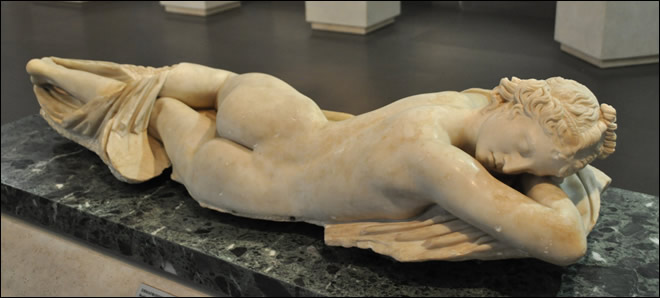
In room 7, the Hermaphrodite is one of the finest examples of this frequently treated subject, probably a copy of a Greek work. The work is best admired from both sides, revealing the male and female nature of the sleeping figure.
The Nereid Thetis, accompanied by a triton at her feet, is pensive. She may already foresee the tragic destiny of her son Achilles.
Room 12, where it is worth lingering, is essentially devoted to the Portonaccio sarcophagus illustrating a battle between Roman soldiers and Sarmatians. The scenes, in the style of those on the Column of Marcus Aurelius, are easy to observe here. A troubling detail that creates unease: the face of the Roman general above a pair of prisoners is unfinished, perhaps awaiting a purchaser.

Second floor.
This section is certainly the most interesting for its frescoes and mosaics found during excavations or works carried out in Rome and the surrounding area. The columbarium (a structure pierced with niches to hold the urns containing the ashes of the dead) was discovered in the 19th century during works under the Villa Doria Pamphilj.

Above each niche — more than 500 of them — besides the name of the deceased, there is a fresco in dark colours illustrating various subjects: mythology, everyday life, birds, and the classic pygmies fighting animals.

The frescoes of the triclinium of the Villa of Livia were discovered in the 19th century in an underground room that may have served as a summer dining room. To enlarge the space of this fully vaulted room, the decoration running around the four walls shows a luxuriant garden with a great variety of trees where numerous birds disport themselves. The fineness of the drawing and the freshness of the colours make this décor a masterpiece of Roman painting of the 1st century BC.

In the Villa Farnesina, of the Augustan period, rediscovered in the 19th century during works on the banks of the Tiber, the high-quality frescoes and stuccoes were signed by a Greek artist named Seleukos. The frescoes show Dionysiac scenes and Egyptianising motifs perhaps linked to the cult of Isis.
The imperial villa of Baccano, which belonged to the emperor Septimius Severus, yielded a rich collection of mosaics that covered the floor of a bath complex as well as those of the upstairs chambers. The exhibition lets you discover frescoes and mosaics from other villas or baths, brought together here.
